

The Shape of Between

Following the successful collaboration with Galllery GBK Sydney in 2005 we are pleased to present new work from another artist associated with GBK Gallery
Jess MacNeil: The Shape of Between
"The Shape of Between continues MacNeil’s enigmatic extension
of the painting tradition and the convergences of civilisation with the
possibilities of the digital arena. One hundred seconds of footage extended
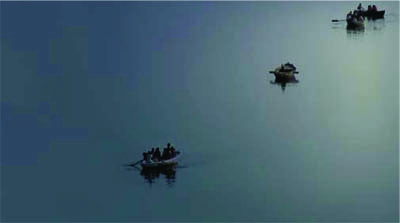
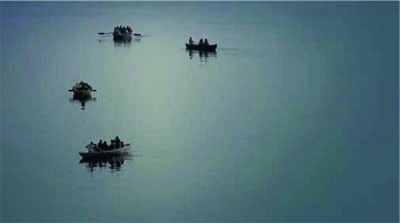
to almost thirteen minutes, the work shows four rowing boats on the Ganges
River captured on a recent stay in Varanasi in India, highlighting the
nuances of the passing of time. Presented without the rigidity of the
single-point perspective in the Opera House Stepsseries, there is no horizon
or shoreline with which to orient oneself, connecting to the Eastern artistic
tradition of multiple-point perspective. The still focal point rests on
one boat at a time, surveying its path through the serene uninterrupted
surface of the Ganges, a river rich with religious and cultural significance
in India. This simple intervention quietly alters both the choreography
and atmosphere of the looped scene each time the ‘focal anchor’
readjusts to the next boat. The boats therefore transcend any initial
associations we may have attributed them and become slow animated ‘pixels’,
responding to the shifts in framing by appearing to skim the water’s
surface at differing rates. Accompanying this looped study is a sparse
electronic sound composition by Marcus Kaiser which continues the idea
of deferred time through cyclical rattles and chimes. As the boat’s
oars rotate in the still treacle of the editing suite, we are led on a
meditative and mediated study of temporal motion.
Like the many imagined faces
of Maximilian, these works operate by momentarily suspending our conventional
perception. By questioning these small but inherited ‘truths’—the
snapshot, the completed canvas, the act of walking a metropolis or traversing
a river—MacNeil draws our awareness to the permeability of time
and the forgotten corners of our assumed reality, refocusing us quite
literally on the ‘shape of between’. "
Clare Lewis July 2006
see entire essay below
Jess MacNeil
14 October- 5 November 2006
Opening Monday 9 October
6 to 9pm
Special during Frieze week open 1-6 Tuesday to Friday
and by appointment:
Saturday & Sunday 1-6
e: exhibitions@elastic.org.uk



Jess MacNeil: The Shape of Between
There is a painting at London’s National Gallery depicting the execution
of the Emperor of Mexico by firing squad. Edouard Manet’s The Execution
of Maximilian (1867) is a strange painting, which has been cut into pieces
and reconstructed onto a stretcher emulating the original scale of the
work, now showing only partial elements of the scene. As a result, the
soldiers’ cocked rifles are aimed at an area of raw blank canvas,
and all that remains visible of Maximilian is a hand, held or restrained
by one of the soldiers. The reasons for its destruction are a mystery.
Be they political or aesthetic censorship, or physical disintegration,
the result is an intriguing tableaux which both communicates and obscures
a moment in time. This deconstructed work offers an accidental critique
on the effects of history, politics and memory and as such, has always
seemed a contemporary vista despite its historical content. As viewers
instinctively and repeatedly piece together their own version of the obstructed
scene, there is the space to contemplate the reasons for its violent journey
to now.
Jess MacNeil’s practice treats the pictorial plane in a similar
way, allowing absence to play an active role in the interpretation of
her subject matter and medium. Her paintings are executed from personal
photographs, rearticulated in a manner which lays bare the process of
painting. Pencil plans are exposed, and areas are left untended, fragmenting
the completed moment as captured by a photograph. Figurative elements
orchestrate these works; we are drawn towards the girl lost in thought,
the arc of a telegraph cable or the ramshackle shape of foreign villages.
However these interludes are never concrete: details continuously and
abruptly fall away. In their place, abstract colour fields or raw canvas
compete with the representation, as the ground emerges, destabilising
the pictorial subject. As a result, MacNeil’s structures become
fluid and shifting, disallowing our inclination to consume a scene as
a whole, and mirroring the fragmented process of remembrance and understanding.
Questioning the authority of the photographic image as a unit of truth
and permanence, these paintings show a set of personal signifiers which
seem to have undergone the same ravages faced by all technology: subjectivity,
deterioration, obsolescence and slippage. MacNeil explicitly aligns the
medium of paint with the discourse of photography and film, articulating
both her canvases and videos as time-based practices, equally susceptible
to flux and permutation.
Having conducted a sustained investigation into the juncture between painting
and photography, MacNeil’s recent video works are an engaging progression
from the tensions she explores on canvas. The Opera House Steps works
began with a set of photo-paintings of people against the backdrop of
this iconic building’s steps. Isolated by white paint on the photographic
surface, these figures are traced and extended in a linear way, or the
negative space left unpainted in their wake. As if mapping an imagined
path, the unpainted area marks multiple individual journeys, creating
an aesthetic akin to the matrices of the video editing suite. Humans become
non-sequential particles, points for mapping the fluctuations of public
space. In the Opera House Steps video works, the human element has become
implicit, as MacNeil painstakingly removes the physical forms traversing
the steps. All that remains are ghost-like shadows thrown by an anonymous
cast of passers by.
What is striking about this work is the resemblance of the shadows to brushstrokes.They trace the hard edges of the urban step structure, which fills the frame, continuing MacNeil’s painterly trajectory of deconstructing visual codes, and what we see is an engaging observation of the fluidity of human movement and the formalising of human behaviour.The two versions of this work were taken at opposing seasons, and differences in light quality, shadow length and the pace of summer and autumn walkers create contrasting environments in these works. On some level this work makes visible ideas surrounding chaos and complexity theories, as the unpredictable nature of individual destinies are tracked.
It also aligns contemporary digital models with the chrono-photographic
motion studies of the late nineteenth century, as the horizontal planes
break the residue of movement into discontinuous, apparently random sections.
The Shape of Between continues MacNeil’s enigmatic extension of
the painting tradition and the convergences of civilisation with the possibilities
of the digital arena. One hundred seconds of footage extended to almost
thirteen minutes, the work shows four rowing boats on the Ganges River
captured on a recent stay in Varanasi in India, highlighting the nuances
of the passing of time. Presented without the rigidity of the single-point
perspective in the Opera House Stepsseries, there is no horizon or shoreline
with which to orient oneself, connecting to the Eastern artistic tradition
of multiple-point perspective. The still focal point rests on one boat
at a time, surveying its path through the serene uninterrupted surface
of the Ganges, a river rich with religious and cultural significance in
India. This simple intervention quietly alters both the choreography and
atmosphere of the looped scene each time the ‘focal anchor’
readjusts to the next boat. The boats therefore transcend any initial
associations we may have attributed them and become slow animated ‘pixels’,
responding to the shifts in framing by appearing to skim the water’s
surface at differing rates. Accompanying this looped study is a sparse
electronic sound composition by Marcus Kaiser which continues the idea
of deferred time through cyclical rattles and chimes. As the boat’s
oars rotate in the still treacle of the editing suite, we are led on a
meditative and mediated study of temporal motion.
Like the many imagined faces of Maximilian, these works
operate by momentarily suspending our conventional perception. By questioning
these small but inherited ‘truths’—the snapshot, the
completed canvas, the act of walking a metropolis or traversing a river—MacNeil
draws our awareness to the permeability of time and the forgotten corners
of our assumed reality, refocusing us quite literally on the ‘shape
of between’.
Clare Lewis July 2006