|
Joanna
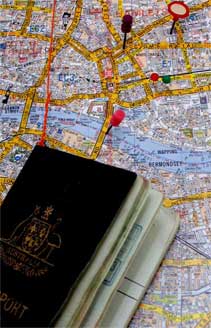
Callaghan navigates geographical points that surround the gallery
via personal history and emotional indicators.
‘Since arriving in London in 1997 I have lived, loved and lost
within a one mile radius of this gallery. This is a map of how I came
to be here and the things that happened.’
more images from etak can be seen here
About
etak
Basic
directions in etak are defined by the places around the horizon where
particular stars rise. The navigator knows star courses between every
pair of islands in their own vicinity. This provides the basis for the
system of knowledge. However stars are not reliable sources of directional
information; they cannot be seen by day or on cloudy nights. When travelling
between one island and another, the navigator keeps in mind a third island,
the etak island to the side of the course. The voyage is imagined in terms
of the movement of the etak island, as if the canoe itself were stationary
while the etak island slid slowly backward along the horizon. Other information
is gathered from the relation between time and land/sea marks and between
land/sea marks and stars.
The etak principal is highly abstract – the reference island is
never in sight and the star positions under which it moves are rarely
visible either. Much of the relevant information comes from dead reckoning,
sea marks, wave patterns and birds however the navigator refers this information
to the imaginary movement of a remote island under the unmarked rising
positions of invisible stars.
I
am interested in the process of navigation (location) and how it forms
and informs the outcome (the located). I am interested in how cognitive
maps are created through information that originates from disparate sources
via contextual frameworks such as historical, personal, virtual, cultural
and political. I am interested in navigation and orientation as metaphor
for displacement and integration.
Joanna
Callaghan
|