Viewing
the Political

Curated by Tina Liveras in collaboration with Deej
Fabyc
A survey of some recent International short film
and video
Featuring Madeline Djerejian, Raimi Gbadamosi
and Rastko Novakovic
feature Artists will be presenting talks during
the exhibition ….
Madeline Djerejian3pm, Sat 10th March
Rastko Novakovic with Steven Ball on the
31st of March at 3pm.
Raimi Gbadamosi 3pm 7th April (note the
gallery will be closed on Sunday the 8th of April)
Please Contact Tina Liveras on 07734 060 139 for further information

Madeline Djerejian
Raimi Gbadamosi
Rastko Novakovic
Reviews of cinematic history like to suggest a change in the role of film
and of filmmakers. While film was once a tool used to strengthen dominant
ideologies, it is now, it would seem, a weapon with which to attack them.
This notion is easy to believe when we compare early propaganda films
to contemporary overt virulent attacks on political and cultural systems
by the likes of Michael Moore, Morgan Spurlock et al. So too, cinema and
television have witnessed an increase in political drama and documentary,
focussing on real life issues, corrupt regimes and the inner workings
of political institutions. On viewing such films, we like to believe we
are finally witnessing the truth and we are often quick to swallow the
vague, rushed findings that are manipulated to create a coherent and convenient
narrative that fits into a tight two-hour schedule suitable for cinema.
And in this modern cinema, with popcorn and surround sound, politics can
quickly become entertainment, a spectacle, something that we consume on
a Friday night.
Clearly we must look elsewhere if we are to find in-depth, genuine and
engaging political discourse in film; to independent productions, and
to art galleries, where politics can be explored in more subtle and less
sensational or narrative-driven terms.
The latest show at Elastic Residence explores the close relationship between
film and politics and features works by Madeline Djerejian, Raimi Gbadamosi
and Rastko Novakovic as well as a series of short films by emerging artists
and filmmakers.
Madeline Djerejian’s video, The Last of Beirut, is a silent film
which, through text and image, constructs a vision of displacement and
loss on the eve of civil war in the Lebanon, 1975. Image and text are
interwoven presenting a fragmentary account that resists narrative coherence
and emphasizes the subjective and contradictory nature of memory. The
exclusion of audio material forces the viewer to rely on text, and thus
slows the process of viewing, creating a mood that is “the antithesis
of spectacle”.
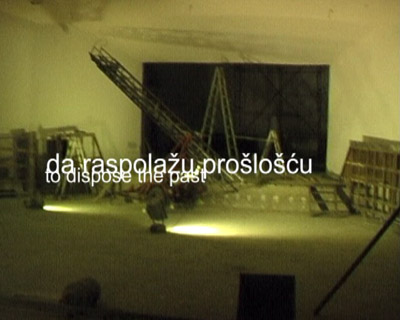
Meanwhile, Rastko Novakovic’s film, Sunday Afternoons in Majdanpek,
takes us to Majdanpek, a devastated mining town in Eastern Serbia. The
camera traces and retraces the same route, to and from the town’s
cinema and each trip offers a new perspective, a different image of the
route. Tri u dva ne ide attempts a cinematic reading of present day writing
in movement and a reading of contemporary representations of Serbia. The
accompanying sounds and voices, political slogans, prayers, songs, intermingle
to form a muddled narrative, which, once again, resists coherence and
invites us to question narrative voices.
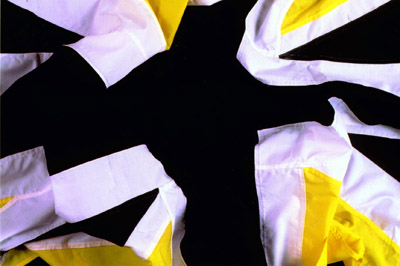
Raimi Gbadamosi’s work is concerned with the inter-relationship
between race, power and language. His website, www.the-republic.net invites
viewers to read dictionary style entries relating to the colours black,
white, and yellow, and to decide which colour they identify with most.
Members of the Republic are issued identity cards (“I am yellow”
etc) and a copy of the constitution. Gbadamosi’s film," Invasion",
asks us again to consider the colours of the human races, black, white
and yellow. Blocks of these colours move slowly and hypnotically across
the screen, changing form and increasing and diminishing in size. The
overwhelming images force us to react subjectively to colour and to explore
its connotations.
Also showing at Elastic will be a series of short films commenting on
the political by a selections of emerging artists and filmmakers…
Noah Angell: Meditations on Violence and Fantasy History (a Kung Fu movie)
Matt Wootton: Dole Scum
David Goodchild: My First Sony
Lyn Lowenstein: Foreign Policy: Martin Luther King Mouthpiece
Shane Davey and Talal Khoury: ‘6| 7 Borders
Peter Griffin: Dream of Innocence
The show opens on Tuesday
6th of March with an opening party from 6-8.30pm
and will run for five weeks
Opening Times:
Saturday and Sunday 13:00 – 18:00
and by appointment.
|
Viewing
the Political

6 March- 15 April 2007
Opening Tuesday 6 March
6 to 8.30pm
Thereafter Open
Saturday 1-6
Sunday 1-6
and by appointment:
|
|
|